Before We Build the Future, We Must Find Its Foundations
The world cannot go green without going underground. A look at why mining's future matters, and the young scientists MINML is bringing into it.
Mention mining to most people and the image is remarkably consistent. An old industry. Environmentally contentious. Slow to change. All hard hats and haul trucks. Perhaps not the industry a bright undergraduate imagines themselves joining, feeling dominated by a previous generation.
That perception did not appear from nowhere. Mining has a long history, and with it, real environmental and social challenges; these deserve scrutiny. But they are no longer the whole story.
A better future will be built from the resources we discover today. As the world moves towards cleaner energy, smarter technologies and greater digital connectivity, the demand for critical minerals will continue to grow. Electric vehicles depend on lithium, nickel and cobalt, renewable energy infrastructure requires copper and rare earth elements, and the AI revolution relies on a vast supply of minerals needed to build the data centres and technologies that power it. The transition to a low-carbon economy will not happen without discovering, extracting and processing the resources beneath our feet.
Mining will therefore play an essential role in enabling the next generation of innovation. The question, then, is not whether the world will mine. The question is whether it can do so better.
The cost of looking in the wrong place
Exploration has always been an exercise in uncertainty. Vast areas of ground are investigated in the hope that a small number become viable projects. Less than 1% of explorations are successful. Every unnecessary survey, every misplaced drill hole and every unsuccessful programme carries a financial and environmental cost. Better information changes that.
The question, then, is not whether the world will mine. The question is whether it can do so better.
At MINML, we believe modern exploration should be driven by the combination of geological expertise and explainable artificial intelligence. By integrating decades of geological, geophysical and geochemical data, our model helps our exploration teams understand what lies beneath the surface before committing to expensive field programmes. More informed targeting means fewer unnecessary campaigns, better allocation of capital and a smaller environmental footprint. Mining will always leave an impact. The responsibility is to ensure every decision is backed by the best science available to minimise it.
But the search for the foundations of the future takes place on two fronts; technology alone does not change an industry. People do.
The second front: people
This summer, MINML set out to find promising young talent, and to point it towards an industry that needs it. We welcomed interns from a range of scientific backgrounds. Some arrived with experience in geology, others from disciplines where mining had barely crossed their minds. What united them was curiosity, technical ability and a willingness to challenge assumptions.
Rather than observing from the sidelines, our interns became part of the team. They contributed to live research projects, working alongside our geologists and machine learning engineers, and saw first-hand how modern exploration really works. Beyond the office, they attended networking events, meeting exploration companies, investors and researchers who are shaping the future of critical minerals.
We know they will leave with something more valuable than a line on their CV: a new perspective.
Mining's future will not be built solely through new discoveries underground. It will also be shaped by the people choosing to build careers around it. If the industry is to become smarter, more sustainable and more representative of the world it serves, it must attract the sharpest minds from every discipline and every background.
Changing mining's image is not simply about changing perceptions. It is about changing reality. We are proud to play a part in that journey.
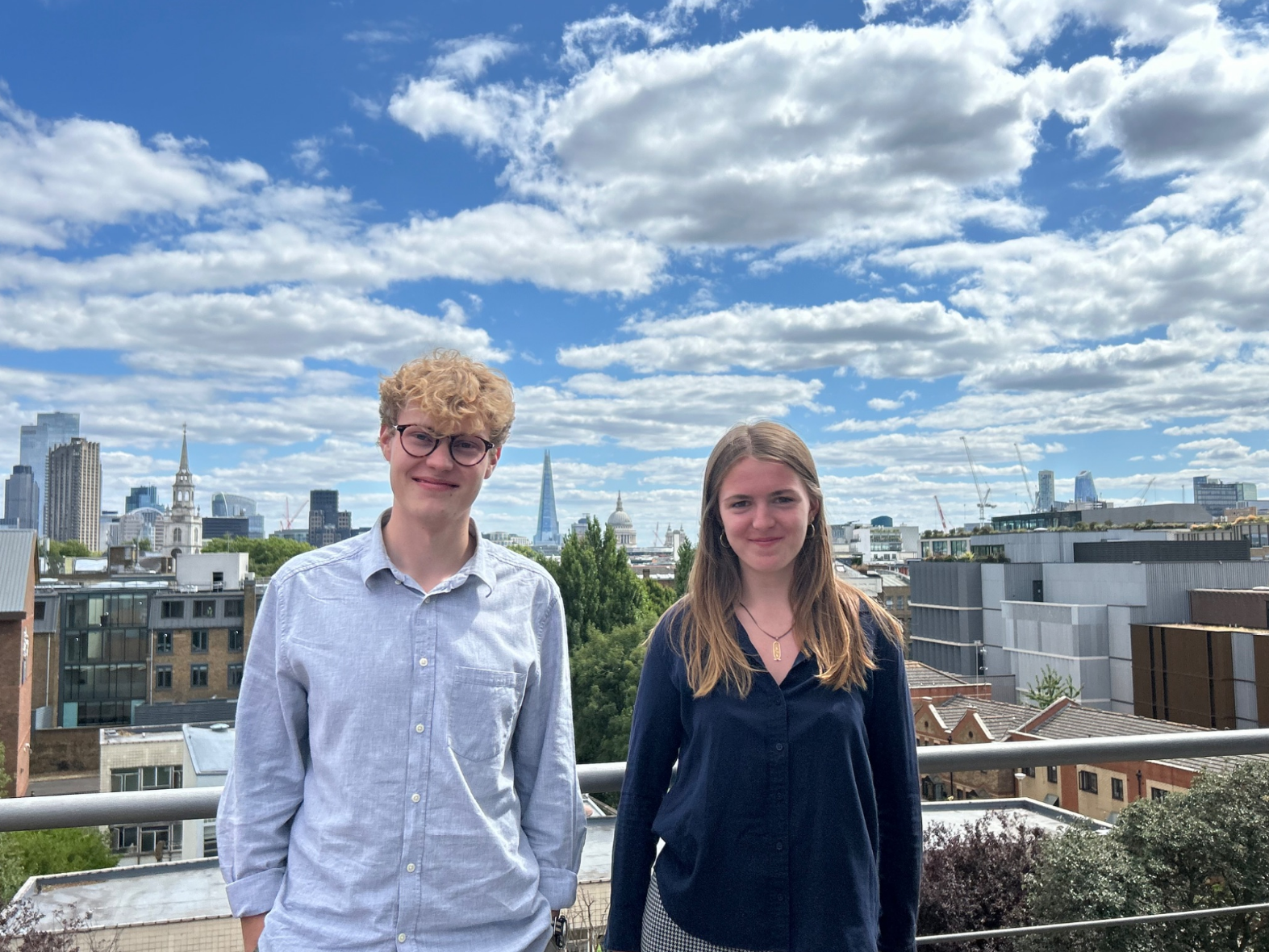
Meet two of them
Alina is a second-year physics student at the University of Oxford. Her project has been forward-looking: extending the capabilities of the model itself and expanding what its features can capture. It is a reminder that the hardest problems in exploration are rarely just geological. They are mathematical, computational, and physical, and they are often cracked by people trained to look at them from a different angle.
Jim is a second-year geology student at the University of York. His work has focused on the easily forgotten yet most important part of any model: the data that feeds it. Every prediction MINML makes rests on the quality and breadth of what goes in, and Jim has hunted down new sources of geological material, assessing them, and preparing them to be folded into the model. This work quietly underpins everything else downstream.
Neither arrived as a finished mining professional. That was the point. They arrived as bright, curious scientists, and over their internship they became part of how the work actually gets done, contributing to live projects alongside our team.