From Sweden to the Subsurface: Key Takeaways from our AI in Mining Keynote
A working view from the leading frontier of AI in mining and mineral exploration.
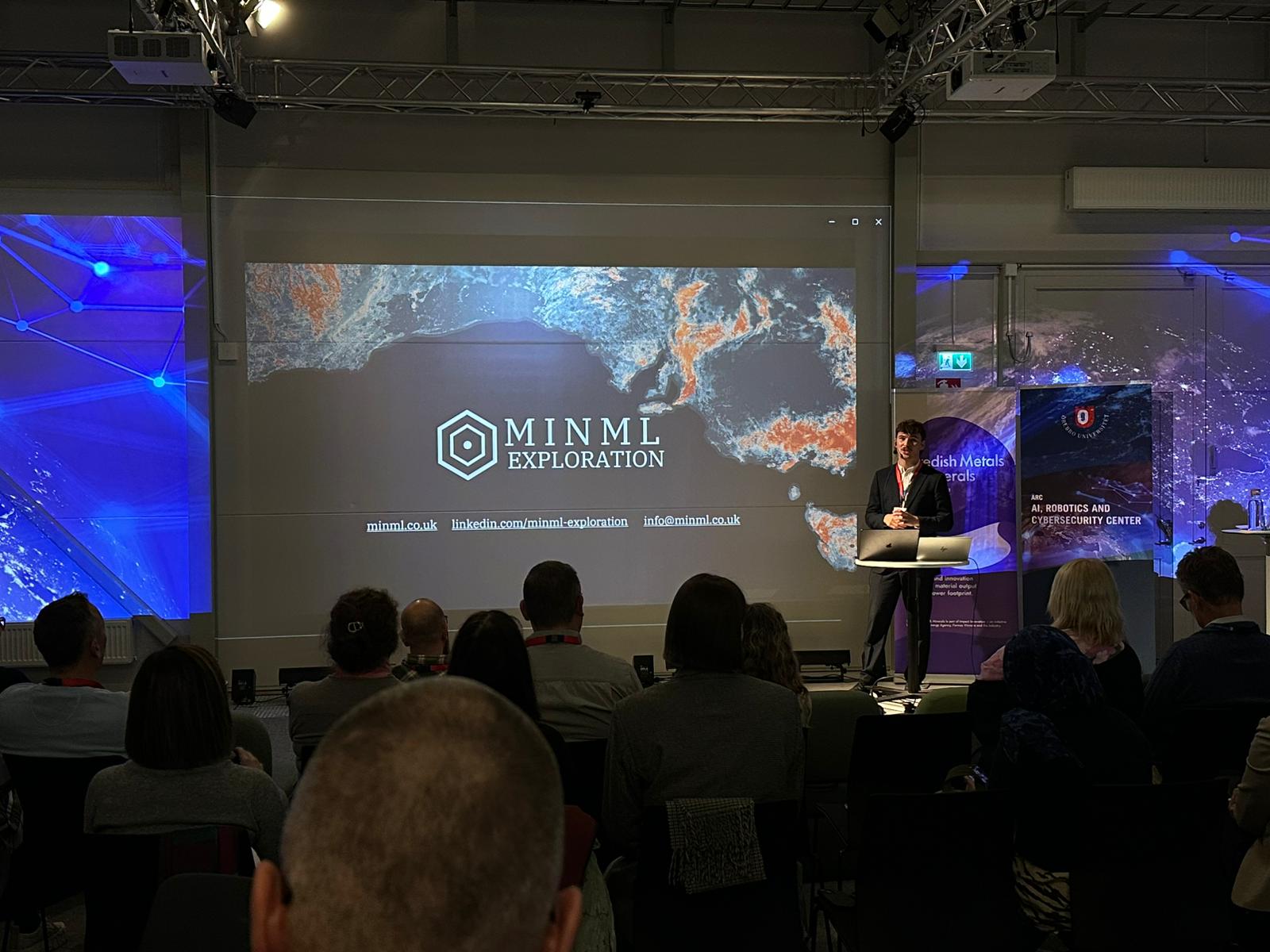
What is the role of AI in mining? It is not a new question, but it is an increasingly pressing one.
Mineral exploration is in structural decline. Discovery rates have fallen by over 50% since 2000, whilst cost per discovery has risen fivefold. This decline is set against a backdrop of unprecedented demand. AI infrastructure build-out, the energy transition, and national security concerns dominate headlines across the industry and beyond.
The tension between the unprecedented demand and the structural decline in supply has turned AI from a 'nice-to-have' future innovation into a pressing strategic mandate.
Across the industry, mining professionals are looking to understand how to incorporate AI into their workflows.
On Tuesday, the 12th of May 2026, MINML were invited to Örebro University, Sweden, to answer just that. Our task was to move beyond the theoretical and to provide a working view from the leading frontier of AI in mining and mineral exploration.
Discovery rates have fallen by over 50% since 2000, whilst cost per discovery has risen fivefold.
The View from Sweden
Sweden has long sat at the forefront of innovation and is widely considered a global leader in sustainable mining. 2026, however, has marked a pivotal shift in its strategic importance. Sweden is no longer just a historical mining powerhouse; it is the frontline in Europe's push for mineral sovereignty.
The Per Geijer deposit was discovered in 2023 and made headlines, not only as Europe's largest known deposit of rare-earth metals, but also as the continent's best shot at breaking dependency on external supply chains. It is this strategic context that has made Sweden one of the most important rooms in which to have the AI conversation.
Örebro University is situated at the heart of Sweden's mining innovation corridor. We spoke to a room of mining professionals and academics working at the cutting edge of the AI question. The consensus was undeniable: AI is no longer a speculative prospect. It is the current state of play for any firm seeking to remain competitive, safe, and efficient in an increasingly high-cost, high-regulation environment.
Beyond exploration, we enjoyed several discussions on the practicalities of AI for enhancing safety and autonomy. We learnt how attendees were leveraging AI to coordinate 'lights-out' underground operations and real-time safety monitoring. The technology is impressive, but there was a consistent theme: the success of AI in mining depends entirely on how it is integrated into existing workflows.
This was the leading insight in our keynote address.
The Keynote: A Working View of AI in Mining
MINML CEO Oliver Croft opened with a statement that drew a moment of pause from the audience.
"AI is not, fundamentally, the solution."
A provocative opening from an AI company at an AI conference. But the qualification that followed is MINML's key takeaway.
AI is not, fundamentally, the solution. AI as a tool, with known limitations and humans firmly in the loop, will be.
The keynote was structured around three pillars where AI is doing real, paid, commercially deployable work in exploration today. Not theoretical. Not in five years. Now.
Key Takeaway 1: Humans Must Stay in the Loop
Before addressing what AI can do, Oliver addressed what it cannot. This framing underpins the implementation of AI across mining.
AI cannot replace fieldwork. Every machine-learning model depends on large volumes of high-quality data, and in mineral exploration, that data must be collected on the ground. Boots are not optional.
AI cannot remove the drill. Every deposit ever worked started with a sample. AI can change where you drill, in what order, and how many holes. It cannot remove the fundamental requirement to drill.
AI cannot take responsibility. When a multi-million-dollar drill programme comes up empty, somebody has to stand in front of a board and explain why. That somebody cannot be an algorithm. The only way to remain properly incentivised to be right is for there to be consequences when you are wrong, and for that, humans must remain in the loop.
This is not a limitation of the technology. It is the precondition for using it well.
The right question is therefore not: will AI replace exploration geologists? It is: where can AI help exploration geologists do this work materially faster, more efficiently, and more accurately?
Key Takeaway 2: The Problems AI Exists to Solve
Unlocking the Data We Already Have
The most underrated development in AI for exploration has nothing to do with predicting where a deposit is. It has to do with the data that already exists, hidden by sheer scale and inconvenient format.
Every exploration team has decades of geological observation buried in scanned drill logs, historical assay reports, and government surveys. More written-down geology than any team could absorb. You could pay a junior geologist to read it for six months and cover perhaps one per cent.
Modern language and vision models let us digitise, structure, georeference, and reason over that material at an industrial scale. Fifty years of reports interrogated by a geologist in a single afternoon. Prospects that were written about, drilled, and forgotten get found again.
To illustrate: on a recent West African project, MINML ingested a full archive of historical documents, cross-referenced them with modern geophysical and geochemical coverage, and delivered a ranked list of leads inside six weeks. The two most prospective were being ground-truthed by a field team as we spoke.
This is not AI replacing a geologist. It is AI doing forty years of reading in 4 hours, so that the geologist can focus on the work that actually needs a human. Unglamorous. And faster moving than anything else in our stack.
Pattern Recognition at Scale
All our clients tell us their project is unique. Whilst they are right, every project is also a member of a family.
A job AI is genuinely good at is finding that family resemblance, across thousands of global deposits that no single geologist could hold in their head across a career. Geology has always been pattern recognition. AI does not change the nature of the work. It changes the size of the library.
There is a deeper point here. Geology is a qualitative, narrative science. We tell stories about rocks. Those stories are essential and will not go away. What AI allows us to do, for the first time, is put numbers on that discipline at scale. The narrative becomes the hypothesis; the model becomes the test.
In practice, this spans a spectrum. At the brownfield end, dense data, tight district, the model interpolates between drilled cells with calibrated uncertainty, completing a partially finished jigsaw. At the greenfield end, sparse local data, continental scale, prior knowledge lives not in drill holes but in model weights, pre-trained on the global record of a deposit family. Almost no real project sits cleanly at either end. The most useful AI stack helps a project move along the spectrum as it matures.
Trust
The technology works. In held-out tests, our models rank drill targets better than the consensus of expert geologists across a wide range of settings. This is no longer the bottleneck.
The bottleneck is that a senior geologist will and always should look at a heatmap and ask, why?
If the only answer is 'because the model said so,' that geologist will do the right thing. They will ignore it. And they should. A single drill programme can cost millions. The downside of trusting a black box is unbounded. That is not anti-AI sentiment. That is rational risk management.
The fix is not more accuracy or more testing. It is legibility. When our model flags copper prospectivity, a geologist can examine exactly what drove that prediction and ask: Does this make geological sense? If yes, confidence builds. If no, it surfaces a data error or a conceptual model worth revisiting. That conversation is the difference between a tool that helps and one that frightens.
Mining verifies everything. JORC, NI 43-101, the auditors, the bank, each assume a clear and defensible audit trail. Anything that breaks it will not be adopted at scale, regardless of accuracy.
With MINML's state-of-the-art machine learning explainability techniques, accountability and auditability are no longer a constraint. Our in-house geology team works to test and validate all model findings, providing a full, detailed explainability report for every project. AI in mining cannot rely on trust alone. The proof is in the science.
Where MINML Fits
Our keynote address in Sweden articulates a clear vision. MINML exists to deliver this vision in practice.
We work as an AI-powered mineral exploration consultancy. Our work sits at the intersection of deep geoscience expertise and cutting-edge machine learning. We will never split the two. Built by geologists, for geologists, explained by geologists. Every model is grounded in earth science. Every output is designed to be interrogated, challenged, and acted on by the geologists who know the ground, with the support of our in-house geology team.
Our workflow integrates directly with your team's existing processes:
Data ingestion and structuring. We work with whatever you have: historical reports, legacy assay databases, government surveys, geophysical grids. We digitise, georeference, and structure it into a form your team can use, and a model can learn from.
Prospectivity modelling. From greenfield target generation at a regional or continental scale, through to brownfield drill targeting with calibrated grade volumes and ranked collar locations. The model matures as your project does.
Explainable outputs. Every prediction surfaces the geological features that drove it. Every model run is reproducible. Every output is designed to survive contact with a JORC-compliant audit.
Human-in-the-loop by design. We do not deliver a black box. We deliver a workflow where your geologists remain in control, remain accountable, and are materially faster and better-informed as a result.
The demand for critical minerals is not slowing down. The window for early adoption of AI-driven exploration is open. It will not stay open indefinitely.
Work With Us
If you are an exploration team, project generator, or mining company looking to understand how AI can be integrated into your workflows, we would like to speak with you.