Notes from Falmouth: The UK Mining Conference
Reflections from the UK Mining Conference 2026 and the government's new Critical Minerals Strategy.
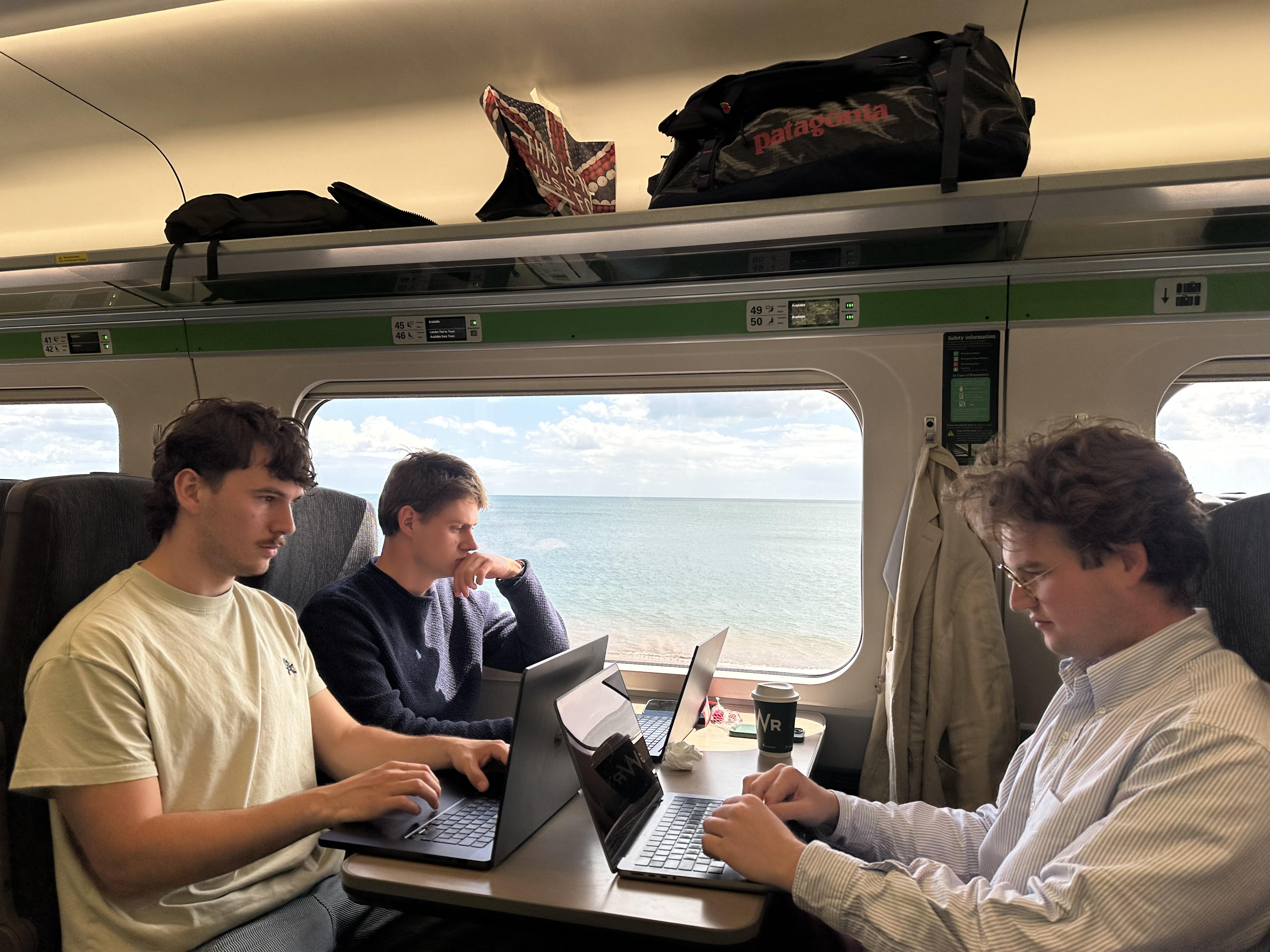
On Tuesday the 9th of June, the MINML team swapped our London HQ for the Cornish coast and headed down to Falmouth for the UK Mining Conference. The conference is of great significance in the UK mining calendar with over 600 attendees representing 295 organisations from across the UK and beyond. As ever, the conference was held in the days before thousands flock to Falmouth for the annual Sea Shanty Festival, offering a perfect opportunity for an early summer MINML retreat.
Besides the pasties, this year's conference had one obvious focal point. In November, the government published 'Vision 2035,' its new Critical Minerals Strategy, and the UK Mining Conference 2026 was the first big gathering where policy met industry. The sentiment MINML took away was one of optimism and positivity.
The Critical Minerals Strategy
Vision 2035 sets some genuinely ambitious markers. By 2035, the UK wants at least 10% of its annual critical mineral demand met by domestic production, up from roughly 6% today, alongside 20% from recycling, and no more than 60% of any single mineral coming from one country. Behind those headlines sit the demand numbers that keep getting quoted: copper demand close to doubling, lithium up by as much as 1,100%.
Much of the strategy's energy goes into the midstream, processing and recycling, which the government sees, fairly, as a real UK competitive advantage.
But sit with the document for a while, and a gap comes into focus. The 2035 production targets don't rest on processing capacity. They rest on a pipeline of deposits that must be found, understood, and de-risked first. The strategy itself admits the timescale problem: the early-stage projects of today are the producers of 2030, 2035 and beyond. You cannot process or recycle a mineral you have not yet discovered.
The Conference
At the conference, we heard from several UK-based operators whose work plugs into the strategy at different stages. Of particular interest were the UK exploration firms uncovering exciting prospects on home soil. Many non-mining folk might think the UK is a country with a strong mining past. We were encouraged to believe it may have an exciting mining future, where British talent and British soil coalesce as a vehicle for growth, jobs, and mineral sovereignty.
You cannot process or recycle a mineral you have not yet discovered.
The likes of Cornwall Resources, Cornish Tin and Lithium, Anglo American, Tamar Minerals, Winshear Metals, Aberdeen Minerals, Argyll Metals, and Cornish Lithium each presented exciting projects from across the British Isles. Commodities included Tin, Lithium, Nickel, Copper, Cobalt, and Polyhalites (fertiliser), with the potential to contribute directly to the Critical Minerals Strategy's 'Vision 2035.'
MINML's Contribution
The Critical Minerals Strategy explicitly acknowledges the demand for new discoveries to support processing, recycling, and supply targets for 2030, 2035, and beyond. Whilst early-stage exploration companies are looking to fill this gap, time and money are often not in their favour.
It is this front end of the funnel, the exploration and targeting, where MINML works, and where many of the 2035 targets will quietly be won or lost.
We build explainable AI across the full exploration pipeline, from data processing through to drill targeting and prioritisation, with geology-first principles embedded in every model and an in-house team that can back-trace every output to the rock it came from.
Two threads of the 'Vision 2035' strategy map almost directly onto what we are building.
The first is access to finance, which the strategy names repeatedly as a barrier. Investors are wary of early-stage projects because the uncertainty is hard to price. Targeting you can interrogate, where every output traces back to the geology behind it, is exactly the kind of defensible decision that makes capital easier to raise. No black boxes; a drill decision you can stand behind in a boardroom.
The second is the strategy's reliance on UK R&D and academic strength. Camborne School of Mines gets a mention, as does the broader research base. That strength only matters if it turns into commercial capability. A London company built by Cambridge Earth Scientists, running projects across five continents, is one version of what that looks like.
For the exploration teams, we serve to de-risk, cut costs, and accelerate their path to discovery.
Beyond the Conference
With two recent additions to the MINML team, we enjoyed the chance to indulge in some local Cornish culture. Pasties for lunch, open water swimming in the evenings, and our senior geologist Ed Smith (Camborne School of Mines alumnus) showing us all the good spots.
We even caught the start of the annual Sea Shanty Festival, the largest free nautical music festival in Europe. Falmouth was transformed into one long harbourside singalong, with every pub and pier filled with the melodic roar of seafaring folk music.
The UK Critical Minerals Strategy often mentions Cornwall's mining heritage and its "industrial renaissance." Standing in this town, listening to sailors' tales centuries in the making, you understand why the mining companies here don't treat critical minerals as an abstraction, but as the next chapter of something they have been doing for a very long time.